The Most Common — and Most Misunderstood — Part of Your HVAC System
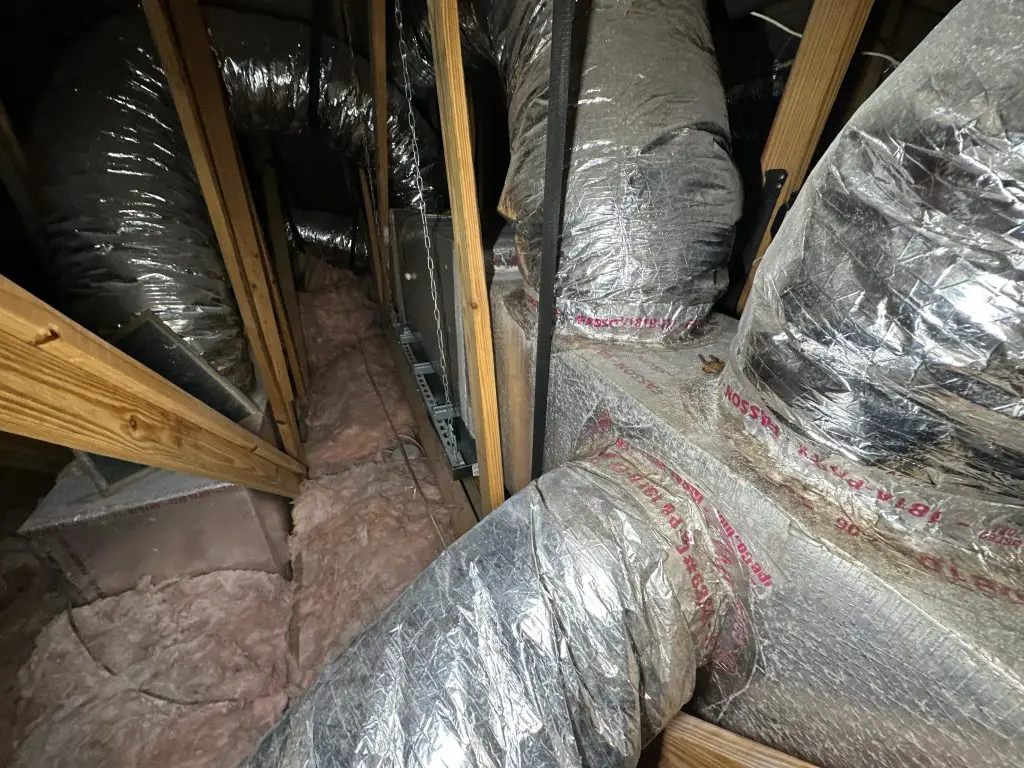
Flexible ductwork — “flex duct” — is the corrugated, insulated tubing that carries conditioned air from your air handler to every supply register in your home. Walk into almost any South Florida attic and you’ll find a web of it snaking between rafters. It’s ubiquitous because it’s fast, cheap, and easy to install. But flex duct comes with real trade-offs that homeowners, property managers, and building engineers need to understand.
What Flex Duct Is Made Of
Standard flexible duct has three layers: an inner plastic liner (polyethylene or metalized film), a middle layer of fiberglass insulation rated at R-6 or R-8, and an outer reinforced plastic jacket. That corrugated inner liner is what creates flexibility — but it also creates airflow friction that smooth rigid ductwork doesn’t have. The more corrugated the surface, the more resistance air encounters on its way to your registers.
Why It’s So Common in South Florida Construction
Builders favor flex duct because it doesn’t require sheet metal fabrication. An installer can unroll it, cut it with a knife, and clamp it in place in minutes. For tract homes built on tight timelines — or for retrofits navigating existing ceiling cavities — that speed has genuine value. The problem isn’t the material itself; it’s the gap between how flex duct is supposed to be installed and how it usually is.
Common Installation Failures
The most frequent problems in the field are:
- Sagging and excess length. Flex duct should be pulled fully taut and cut to the shortest practical run. Every unnecessary foot of material, every dip, adds friction. An over-long, sagging run may deliver only 60–70% of its rated airflow.
- Kinks and sharp bends. Flex duct has a minimum bend radius. A kinked duct can lose half its airflow capacity through that section alone.
- Compression. Flex duct crammed into a tight space or left partially coiled can partially collapse the inner liner, creating a near-total restriction.
- Inadequate support. Industry standards call for supports at 4-foot intervals maximum. Unsupported spans sag, creating turbulence and flow loss at every dip.
What Happens When Flex Duct Is Installed Poorly
Airflow restriction has a cascading effect on your whole system. Rooms don’t receive enough conditioned air — so temperatures swing and humidity stays elevated in the spaces that need dehumidification most. At the air handler, reduced airflow causes the evaporator coil to ice over, which can damage refrigerant lines and cause condensate overflow. Chronically restricted ductwork also forces your blower motor to work harder, significantly shortening its service life. The U.S. EPA consistently identifies HVAC underperformance as a driver of indoor air quality problems — and ductwork restriction is one of the most common causes of that underperformance.
When Flex Duct Makes Sense — and When It Doesn’t
Flex duct is well-suited for short branch runs (14 feet or less) and for final connections between rigid duct and registers. It’s poorly suited for long straight runs, high-velocity systems, or any application requiring tight airflow consistency. SMACNA and ACCA guidance prioritizes rigid metal ductwork for main trunk lines in both residential and commercial applications for exactly this reason.
In South Florida’s hot-humid climate, where your HVAC system carries the full load of both cooling and dehumidification, ductwork quality isn’t a detail — it’s foundational. If your system struggles to maintain comfort, or your energy bills seem high relative to your square footage, a ductwork inspection is a logical first step. Qualified IAQ contractors like Full Spectrum Environmental and Green Fox Air Quality can evaluate duct performance as part of a comprehensive HVAC and air quality assessment.
Bottom Line
Flex duct is a practical tool when used correctly — short runs, fully extended, properly supported, with gentle bends. When it’s installed carelessly (which is more often than not), it’s one of the most common causes of HVAC underperformance and chronic indoor air quality problems in South Florida homes.