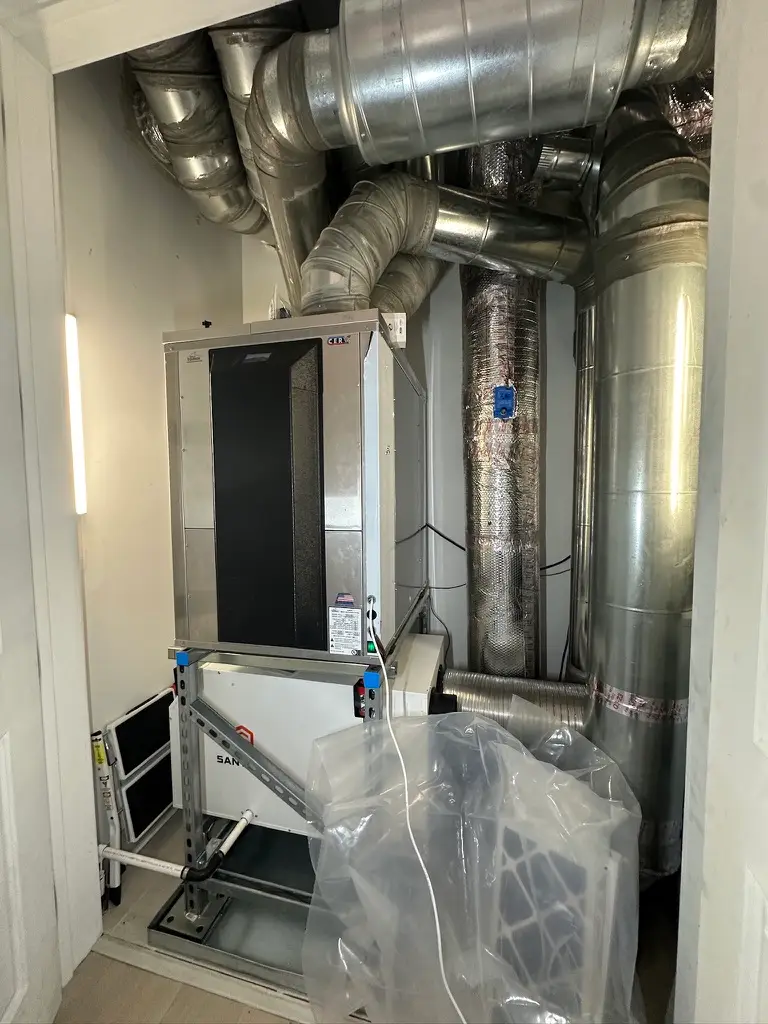
Fresh Air Is Essential — But in South Florida, It Comes With a Cost
Tight, well-insulated homes are more energy-efficient than drafty ones — but they come with a trade-off: without deliberate ventilation, indoor air quality deteriorates. Carbon dioxide builds up, humidity becomes trapped, VOCs from building materials and cleaning products accumulate, and odors linger. The solution is mechanical ventilation — but in South Florida’s hot, humid climate, simply punching a hole in the wall and pulling in outside air is a recipe for massive humidity loads and energy penalties. That’s where an Energy Recovery Ventilator, or ERV, comes in.
What an ERV Does
An ERV is a ventilation device that exchanges stale indoor air for fresh outdoor air — but does so by transferring both heat and moisture between the outgoing and incoming airstreams. The two air streams pass on opposite sides of an energy exchange core (typically an enthalpy wheel or a static plate exchanger) without mixing. In cooling season, the warm, humid outdoor air is pre-cooled and pre-dried by the cooler, drier exhaust air before it enters your HVAC system. In heating season, the process reverses — warm exhaust air pre-heats the incoming cold fresh air.
The result: you get continuous fresh air ventilation while recovering most of the energy (and in an ERV, much of the moisture) that would otherwise be lost. Typical ERVs recover 70–80% of both sensible (temperature) and latent (moisture) energy.
ERV vs. HRV: What’s the Difference?
An HRV (Heat Recovery Ventilator) transfers heat between airstreams but not moisture. That’s appropriate in cold, dry climates where you want to exhaust moisture out of the home. An ERV transfers both heat and moisture — which is exactly what you want in South Florida. When outdoor air is at 90°F and 85% relative humidity, the last thing you want is to fully load your air conditioner with that moisture. The ERV pre-conditions the incoming air before it reaches your evaporator coil, reducing your system’s dehumidification burden and your energy bills.
Why ERVs Are Particularly Valuable in South Florida
South Florida homes are increasingly built or remodeled to be tight — modern spray foam insulation, impact windows, and minimal infiltration are the norm in quality construction. Without mechanical ventilation, these homes rapidly accumulate elevated CO₂, humidity, and contaminants. At the same time, the energy cost of ventilating with unconditioned outdoor air in a climate that’s hot and humid 9 months of the year is enormous.
An ERV solves both problems. It satisfies the ventilation requirements of ASHRAE 62.2 (Ventilation and Acceptable Indoor Air Quality for Residential Buildings) while minimizing the energy and humidity penalty of introducing outdoor air. The EPA and the U.S. Department of Energy both identify ERVs as an effective strategy for balancing ventilation and energy efficiency in hot-humid climates.
Is an ERV Right for Your Home?
ERVs are most valuable in tightly built homes and in homes where occupant density is high (families with children, frequent guests). If your home tests at less than 3 air changes per hour (ACH) under blower-door test conditions — as many modern South Florida homes do — mechanical ventilation of some kind is likely appropriate. Whether an ERV is the right choice versus a simpler exhaust-only or supply-only ventilation strategy depends on your specific building envelope, HVAC system, and occupancy patterns.
A qualified HVAC and IAQ professional can evaluate your specific situation. Contractors like Full Spectrum Environmental and Green Fox Air Quality work with South Florida homeowners and building managers to assess ventilation adequacy and recommend appropriate solutions.
Bottom Line
In South Florida’s hot-humid climate, an ERV is one of the smartest investments you can make for indoor air quality. It delivers the fresh air your home needs while recovering the energy and moisture that would otherwise turn your fresh-air ventilation into an expensive humidity problem.