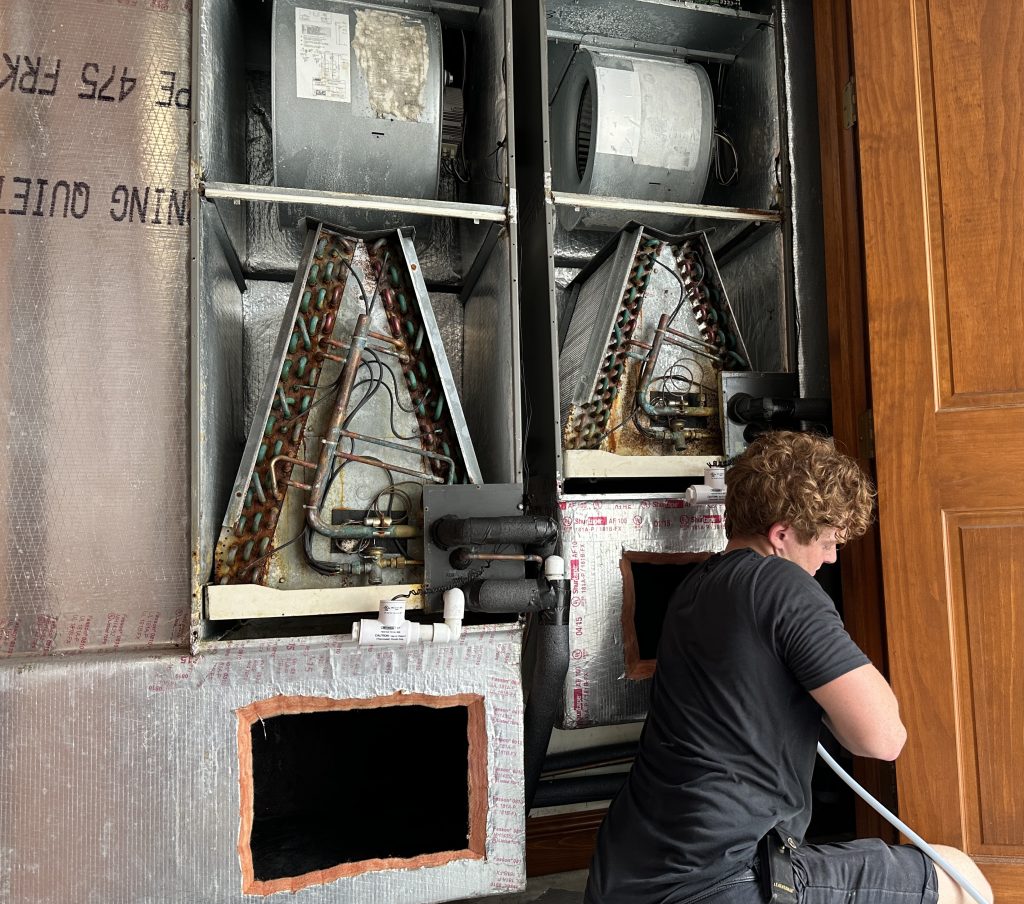
What Duct Cleaning Actually Involves
A professional duct cleaning is a mechanical process. It is not a spray, a fogging treatment, or a chemical application. The goal is to physically remove accumulated dust, debris, biological material, and other contaminants from inside your HVAC duct system — including supply ducts, return ducts, registers, diffusers, air handler components, and coils.
The process typically takes two to four hours for a standard residential system, and involves placing the system under negative pressure while using mechanical agitation to dislodge debris and capture it in a collection device.
Equipment That Should Be Used
Legitimate duct cleaning requires commercial-grade equipment. At minimum, a contractor should use:
- High-powered truck-mounted or portable HEPA vacuum — capable of putting the system under negative pressure and filtering captured particles to prevent them from being released into the living space
- Contact vacuum tools — inserted into the ductwork to agitate debris at the duct wall surface
- Air whips or skipper balls — pneumatic tools that use compressed air to dislodge debris as they move through the duct
- Video inspection capability — before-and-after documentation of what was found and removed
If a contractor arrives with a residential shop vac and a few brushes, that is not a duct cleaning — it is a duct inspection at best.
When Duct Cleaning Is (and Is Not) Worth It
The EPA notes that duct cleaning has not been proven to prevent health problems in the absence of actual contamination. That said, there are specific situations where duct cleaning provides clear value:
- After water intrusion, flooding, or roof leaks that may have introduced moisture into the duct system
- When visible mold is present inside ducts or on HVAC components
- After construction or renovation that produced significant dust inside the living space
- When there is documented evidence of pest activity inside the ductwork
- When the system has never been cleaned and is more than 10–15 years old with a history of poor filtration
Routine preventative duct cleaning every year or two, marketed heavily by some contractors, is generally not supported by evidence for systems with good filtration and no known contamination events.
What to Look for in a South Florida Duct Cleaning Company
South Florida’s humidity creates conditions where duct systems can support mold growth more readily than in drier climates. When evaluating contractors:
- Ask whether they follow NADCA (National Air Duct Cleaners Association) ACR standards — the industry benchmark for source removal cleaning
- Confirm they use negative pressure throughout the process, not just at the end
- Request before-and-after photos or video documentation
- Be cautious of extremely low prices — thorough duct cleaning for a standard home costs $400–$800+. Prices significantly below that often indicate a bait-and-switch model
- Ask about coil cleaning — the evaporator coil inside the air handler is often the most contaminated component and should be addressed at the same time
Duct Cleaning vs. Duct Replacement
In some South Florida homes, particularly those with older flex duct that has collapsed, deteriorated liner, or chronic moisture problems, cleaning may not be the right answer. If ductwork is physically compromised, cleaning extends the life of a failing system rather than solving the underlying problem.
A qualified HVAC contractor or IAQ professional can assess whether cleaning, encapsulation, or full replacement is the appropriate course of action for your specific system.