The Often-Overlooked Piece of Commercial Building HVAC
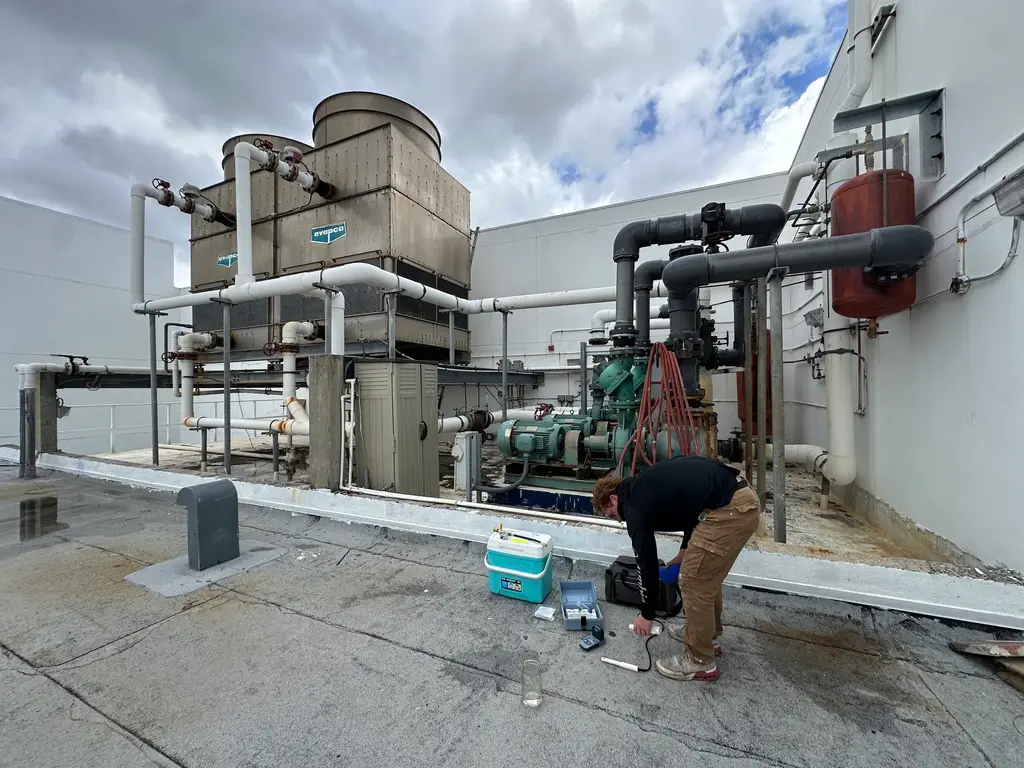
If you’ve ever looked at the roof of a large commercial building and seen a large structure that resembles a big fan or vented enclosure with a gentle mist or vapor rising from it — that’s a cooling tower. Cooling towers are a fundamental component of many large commercial HVAC systems, particularly those using chilled water plants or water-source heat pump loops. They’re highly effective at rejecting heat, they’re relatively inexpensive to operate, and they also carry a significant safety obligation that every building manager needs to understand.
What a Cooling Tower Does
A cooling tower’s job is to reject heat from a water system to the atmosphere. Hot water from the condenser side of a chiller (or from a water-source heat pump loop that has accumulated too much heat) is pumped to the top of the cooling tower and distributed over fill media — a large surface area designed to maximize contact between water and air. Large fans draw air through the tower. As water evaporates, it cools the remaining water dramatically — each pound of water that evaporates removes about 1,000 BTU of heat from the stream. The cooled water is collected at the bottom and returned to the system.
This evaporation process is extremely efficient at heat rejection, which is why cooling towers are so common in large building HVAC systems. But evaporation also means water is constantly being consumed and the dissolved solids in the remaining water are concentrating — which is why cooling towers require active water treatment.
Open vs. Closed Loop Towers
Open-circuit cooling towers expose the process water directly to the atmosphere. This maximizes heat transfer efficiency but exposes the water to airborne contamination and requires more aggressive treatment. Closed-circuit (fluid cooler) designs keep the process water in a sealed coil and cool it by spraying a separate water stream over the coil — the process water never contacts the atmosphere. Closed-circuit designs are more expensive but reduce contamination risk and water treatment complexity.
The Legionella Risk — and Why It’s Serious
Cooling towers create the ideal conditions for Legionella pneumophila — the bacteria that causes Legionnaires’ disease — to multiply. Warm water (typically 77–113°F), aerosolization (water droplets dispersed by the fan and evaporation), and nutrients from organic matter in the water system provide everything Legionella needs to thrive. When contaminated aerosols from a cooling tower drift downwind and are inhaled, they can cause Legionnaires’ disease — a severe pneumonia with a case fatality rate of approximately 10% in the general population and higher in vulnerable individuals.
Outbreaks linked to cooling towers are not rare. The CDC, OSHA, and ASHRAE Standard 188 all provide guidance on Legionella risk management in cooling towers. ASHRAE 188 establishes the framework for a Water Management Plan — the industry standard approach to controlling Legionella risk in building water systems including cooling towers.
What a Water Management Program Involves
A compliant cooling tower water management program includes:
- Regular biocide treatment to control bacterial growth (chlorine or bromine-based programs, or non-halogen alternatives)
- Blowdown management (removing concentrated water and replacing with fresh makeup water to control dissolved solids)
- Regular cleaning and inspection of tower fill, basin, and distribution decks
- Environmental testing for Legionella at defined intervals
- Response protocols when testing indicates elevated Legionella levels
Building managers in Florida should also be aware that the Florida Department of Health has specific regulations for cooling tower registration and inspection in certain occupancy categories. Non-compliance is a liability exposure no building owner should accept.
What Building Managers Should Do
If your building has a cooling tower, you should have a documented Water Management Plan, a qualified water treatment contractor, and a schedule of regular Legionella testing. If you’re uncertain about the status of your cooling tower maintenance program, a professional assessment is a sensible starting point. IAQ and building systems professionals like Full Spectrum Environmental and Green Fox Air Quality can evaluate building HVAC systems and connect you with appropriate specialists.
Bottom Line
Cooling towers are efficient, cost-effective heat rejection systems — but they require rigorous water treatment and ongoing maintenance. The Legionella risk is real, well-documented, and entirely manageable with a proper water management program. For any building with a cooling tower, this is not an optional maintenance item.