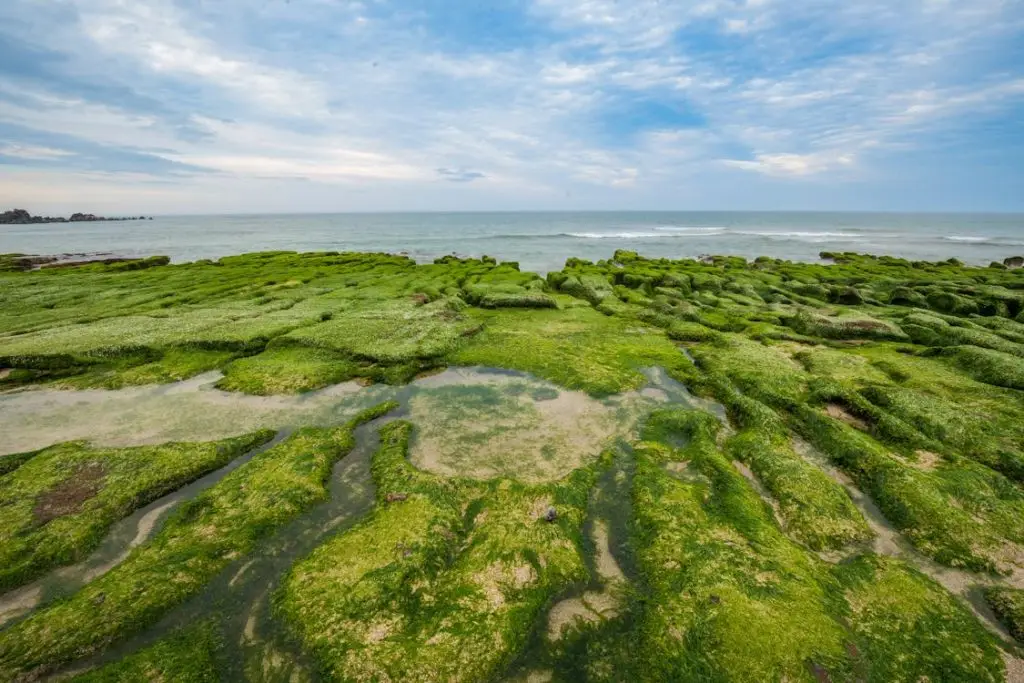
What Is Red Tide?
Red tide — formally known as a Karenia brevis harmful algal bloom (HAB) — is a naturally occurring coastal phenomenon that periodically affects parts of Florida’s shoreline. It is not a constant or uniform threat across South Florida: blooms occur episodically, most commonly along the Gulf Coast from Lee and Collier counties northward through Sarasota, and less frequently along the Atlantic coast. Its direct indoor air quality impact is largely limited to homes and buildings situated close to the water — beachfront properties, waterfront condos, barrier island communities, and similar coastal locations.
When bloom concentrations exceed 100,000 cells per liter, Karenia brevis produces brevetoxins: potent neurotoxic compounds that become aerosolized by breaking waves and onshore winds. Under the right wind conditions, this aerosol can travel roughly 1–2 miles inland — which also illustrates the geographic boundary of meaningful exposure. Beyond that range, concentrations typically drop to levels that pose little practical indoor air quality concern. The Florida Fish and Wildlife Conservation Commission (FWC) actively monitors bloom activity along both coastlines, and their real-time reports are the best resource for knowing whether an event is occurring near you.
Who Actually Needs to Pay Attention
If your home is several miles or more from the shore, you are unlikely to experience meaningful indoor brevetoxin exposure, even during significant bloom events. Red tide is a real and sometimes serious concern, but it is a highly localized one. The residents who should take it seriously are those in beachfront properties, waterfront condos, barrier island communities, and homes within approximately one to two miles of an active Gulf or Atlantic coastline bloom.
For most inland South Florida residents, the more relevant year-round IAQ priorities remain humidity control, mold prevention, and HVAC maintenance — not red tide. That said, if you travel frequently to the coast, own a coastal vacation property, or have family members with asthma or COPD who spend time near the water during bloom season, understanding how brevetoxins behave indoors is genuinely useful.
How Brevetoxins Get Inside Coastal Homes
Many coastal residents assume that closing their windows during a red tide event is enough. It helps — but it is far from sufficient for homes close to an active bloom. Brevetoxin aerosol particles are ultrafine, typically sub-2.5 microns in diameter. That places them in the PM2.5 category that the EPA identifies as the most health-relevant particle size range. Standard 1-inch HVAC filters rated MERV 8 or below — the type found in most Florida homes — capture fewer than 20% of particles in this size range.
When a coastal home’s air handler pulls in outdoor air through a fresh-air intake damper, it can draw brevetoxins directly into the duct system, distributing them throughout every room. Research published in Environmental Health Perspectives has shown that indoor brevetoxin concentrations in shoreline residences can approach outdoor levels if HVAC systems are not managed properly during bloom events. This dynamic is specific to homes within the aerosol travel range — it is not a concern for homes well away from the coast.
Health Effects for Those Directly Exposed
For otherwise healthy people with brief exposure near an active bloom, symptoms are typically self-limiting: coughing, sneezing, watery eyes, and throat irritation that resolve within an hour of moving away from the exposure zone. For vulnerable populations in directly affected coastal areas, however, the stakes are meaningfully higher:
- Asthma patients: Brevetoxins are documented bronchoconstrictors. The American Academy of Allergy, Asthma & Immunology (AAAAI) has noted that red tide exposure can trigger acute asthma attacks even in individuals with well-controlled disease. Florida emergency department data shows measurable spikes in asthma visits during significant bloom events in Gulf Coast counties.
- COPD patients: Studies have documented meaningful declines in FEV1 (forced expiratory volume) during high-exposure periods for those with chronic obstructive pulmonary disease living near active blooms.
- Children and the elderly: Smaller lung volumes, less developed or diminished immune function, and more time spent indoors in coastal areas all increase effective dose. The impact is cumulative during extended bloom events, particularly for those in beachfront or waterfront residences.
Protecting Your Coastal Home During an Active Bloom
If you live close to the shore and FWC reports confirm an active bloom in your area, the following steps provide meaningful protection. These measures are specifically relevant for coastal and near-coastal residents — if you’re well inland, your standard HVAC maintenance routine is sufficient and red tide is not a reason to modify it.
Upgrade Your HVAC Filter Temporarily
During an active nearby bloom, temporarily upgrade to a MERV 13 filter. This captures greater than 85% of PM2.5-range particles. A word of caution: higher-MERV filters increase static pressure — some residential systems are not designed for filters above MERV 11. A qualified HVAC technician can check this in minutes.
Close Your Outdoor Air Damper
Switch your HVAC system to full recirculation mode during active bloom events with onshore winds. If your system has a mandatory minimum fresh-air ventilation requirement per ASHRAE 62.2, consider programming it to run the fresh-air cycle only during low-wind hours — typically overnight — rather than continuously during peak daytime onshore breeze conditions when aerosol concentrations near the coast are highest.
Run a Portable HEPA Purifier in Bedrooms
A standalone True HEPA air purifier (not “HEPA-type” — the distinction matters) provides a useful secondary line of defense in sleeping areas of coastal homes. Use the AHAM CADR (Clean Air Delivery Rate) rating to match the unit to your room size: a 200 sq ft bedroom needs a CADR of at least 130 CFM for adequate air changes per hour. Run it continuously while the bloom is active offshore.
Seal Infiltration Points
Fine particles enter passively through door thresholds, window frame gaps, recessed lighting penetrations, and HVAC cabinet seams. A weatherstripping inspection before bloom season — addressing any visible gaps with foam or silicone — meaningfully reduces passive infiltration for homes near the shoreline.
After the Bloom Passes
Once FWC data confirms the bloom has dissipated in your area, it is worth having your air handler coil and drain pan inspected. These are prime locations for biofilm buildup and accumulated fine particulates. NADCA’s professional duct cleaning standards provide the benchmark for a proper post-bloom system cleaning, including the coil surfaces where brevetoxin residue can concentrate.
If anyone in your household experienced respiratory symptoms during the bloom, an indoor air quality test can confirm whether indoor particle concentrations have normalized. Surface deposition on HVAC components, bedding, and furniture can create a lingering indoor exposure source even after the outdoor bloom has fully dissipated.
The Bottom Line
Red tide is a real, well-documented IAQ concern — but a geographically specific one. If you live in a beachfront home, waterfront condo, or barrier island community within roughly a mile of the Gulf or Atlantic coast, a significant bloom event is worth taking seriously, especially if anyone in your household has asthma, COPD, or reduced lung function. The same IAQ habits that protect against mold and Florida humidity — high-efficiency filtration, a well-sealed building envelope, and active monitoring — also provide meaningful protection during bloom events.
For the majority of South Florida residents who live several miles or more inland, red tide is not a meaningful indoor air quality risk. Check FWC updates if you visit the coast during bloom season, but your IAQ investment is better directed at the humidity control and mold prevention challenges that affect every home in the region year-round.