Two Numbers That Tell You Almost Everything About Your Building’s Air
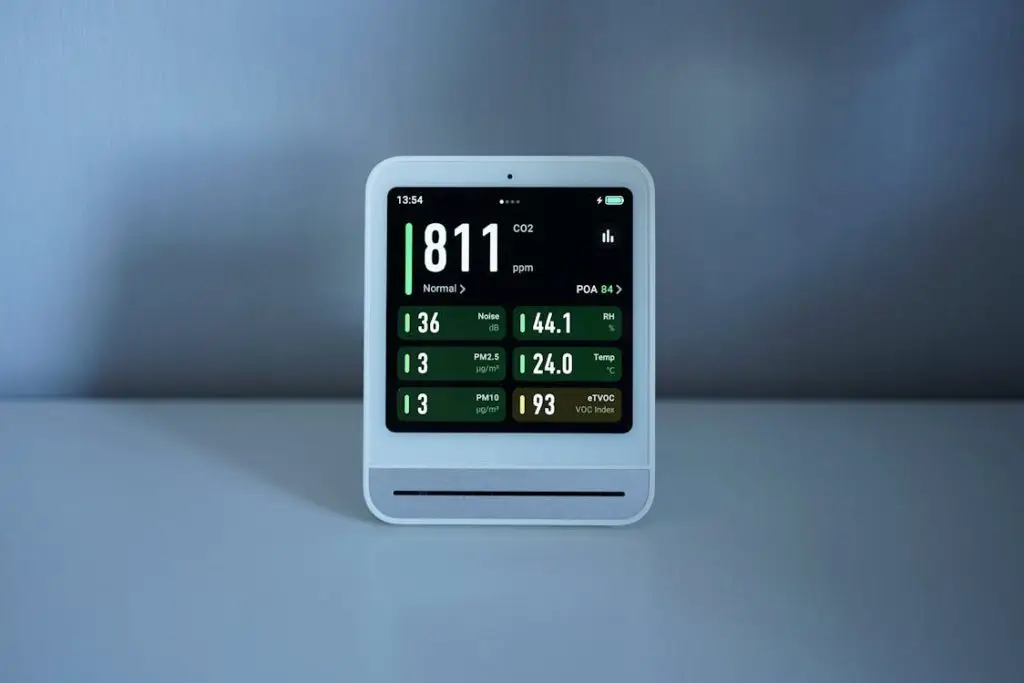
Building managers and facility teams often have dashboards full of metrics — energy consumption, equipment runtimes, maintenance schedules, occupancy data. But when it comes to indoor air quality, two measurements provide more actionable information than all the others combined: CO2 concentration and relative humidity. Both are inexpensive to monitor continuously, both have well-established health and comfort thresholds backed by ASHRAE and EPA research, and both are leading indicators of problems that become expensive when caught late.
CO2: The Proxy for Ventilation Adequacy
Carbon dioxide is not itself a health hazard at the concentrations found in occupied buildings — it becomes dangerous only above 5,000 ppm (the OSHA time-weighted average limit) or 40,000 ppm (immediately dangerous to life). But in the range that buildings actually operate — 400 to 2,000 ppm — CO2 concentration serves as an excellent proxy for the adequacy of outside air ventilation relative to occupant load.
The reasoning is straightforward: humans exhale CO2 at a predictable rate (roughly 200 ml/min at rest, more during activity). Outdoor air contains approximately 420 ppm CO2 (current atmospheric levels). As occupants fill a space and breathe, CO2 rises. The rate of rise depends entirely on how much fresh outside air is being supplied to dilute it. ASHRAE Standard 62.1 (commercial buildings) and 62.2 (residential) establish minimum ventilation rates designed to keep CO2 below approximately 1,100 ppm in normally occupied spaces — the threshold above which occupants commonly report stuffiness, reduced concentration, and fatigue.
Research from the Harvard T.H. Chan School of Public Health (the COGFx study) found that cognitive performance scores dropped measurably as CO2 rose from 550 ppm to 1,000 ppm, and dropped dramatically above 1,000 ppm. For office buildings and schools, this has direct productivity and learning implications. Building managers who monitor CO2 and maintain levels below 800 ppm are operating a measurably better environment than those running systems on fixed schedules regardless of actual occupancy.
CO2 Thresholds to Know
- 400–600 ppm: Excellent. Near outdoor levels. Strong ventilation or low occupancy.
- 600–1,000 ppm: Acceptable. ASHRAE 62.1 minimum compliance range for most occupancy types.
- 1,000–1,500 ppm: Marginal. Many occupants will notice stuffiness. Ventilation rate or occupant density should be reviewed.
- Above 1,500 ppm: Poor. Investigate HVAC system function, outside air damper position, and filter condition. At this level, pathogen transmission risk is also elevated because expired air is not being diluted adequately.
Relative Humidity: The Mold and Comfort Indicator
In South Florida’s climate, relative humidity is the most operationally critical IAQ parameter for commercial buildings. The EPA and AIHA both identify 30–50% RH as the target range for occupied commercial spaces. Above 60% RH, dust mite populations proliferate in carpeting and soft furnishings, and mold colonization risk on building materials rises sharply. In South Florida, achieving 50% or below requires active dehumidification — passive AC cooling alone is frequently insufficient, particularly during shoulder seasons when cooling loads are low but outdoor dewpoints remain high.
For building managers, humidity above 60% RH on a persistent basis (more than 48 continuous hours per the IICRC S500 water damage standard) in any area of the building should trigger investigation: Is the HVAC system sized and operating correctly? Are there envelope air leaks allowing unconditioned outdoor air infiltration? Is there a plumbing leak or roof intrusion adding moisture load? A persistent 65% RH reading is a mold problem in waiting.
Below 30% RH (less common in South Florida but possible in heavily air-conditioned server rooms or during cool, dry winter periods), occupant comfort suffers through dry mucous membranes, increased static electricity, and elevated respiratory infection susceptibility. ASHRAE Standard 55 establishes the thermal comfort envelope that includes humidity as a key parameter.
How to Monitor Both Parameters Cost-Effectively
Affordable IoT-connected CO2 and RH sensors are now available for $50–$200 per unit and can provide continuous logging to cloud dashboards. For a small office building, placing sensors in high-occupancy zones — conference rooms, open office areas, break rooms — provides representative coverage. For larger buildings, sensors in each HVAC zone provide the granularity needed for demand-controlled ventilation (DCV) operation, where ASHRAE 62.1 allows ventilation rates to modulate based on real-time CO2 feedback rather than running at maximum rates regardless of occupancy. DCV is documented to reduce ventilation energy costs by 20–40% in variable-occupancy buildings while maintaining or improving air quality.
The data from continuous monitoring also provides defensible documentation for LEED certification, WELL Building Standard compliance, and increasingly common lease requirements from corporate tenants who specify minimum IAQ standards as part of lease negotiations.